Flagship · open beta
Nexus — the whole station in one modern app.
A free, open-source ham radio workstation that a brand-new Technician can set up in minutes and a seasoned DXer won't outgrow. Built in Rust, GPL-3.0.
v0.3.0 open beta · Windows x64 · ~210 MB, everything bundled · GPL-3.0
What it does
Six reasons it replaces a screen full of apps
On the air in minutes
A three-step wizard detects your radio — USB descriptors for serial rigs, LAN discovery for a FlexRadio — and fills in CAT and audio with one click. Around fifty rigs curated, Hamlib bundled: nothing else to install. A license-class guard in every transmit path keeps Nexus from keying outside your privileges.
Digital done right
FT8/FT4 with an auto-sequencer built to WSJT-X's behavior — verified against a 207-row parity matrix — plus country and worked-before flags on every decode, LoTW-member marks, a modern sortable roster, DXpedition hound mode, and one-click work-it that jumps band, mode, and frequency atomically.
Propagation you can act on
A statistical band-opening detector anchored to your station — not the global firehose — plus a native, in-app port of ITU-R P.533, the VOACAP-class link-budget standard. A shaded 3-D globe with greyline, live spots, aurora, measured MUF, and moving satellites. Every prediction honestly labeled modelled.
DX chasing that knows your log
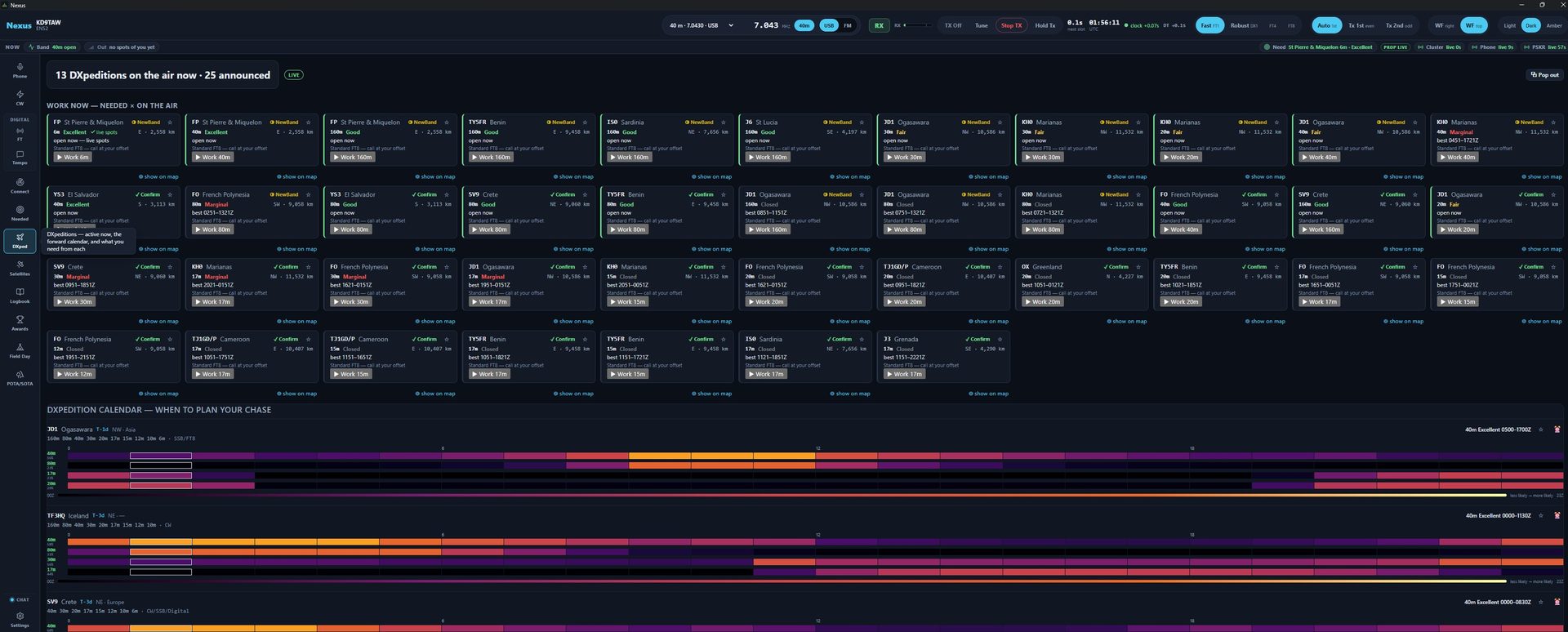
The Needed board ranks every station on the air by what it's worth to your log — and shows who near you actually heard them, so you know the path is real before you call. DXpedition calendar with modelled windows and wake-me alarms. DXCC, Challenge, WAS, and WAZ computed offline with confirmation-source honesty.
Every mode is first-class
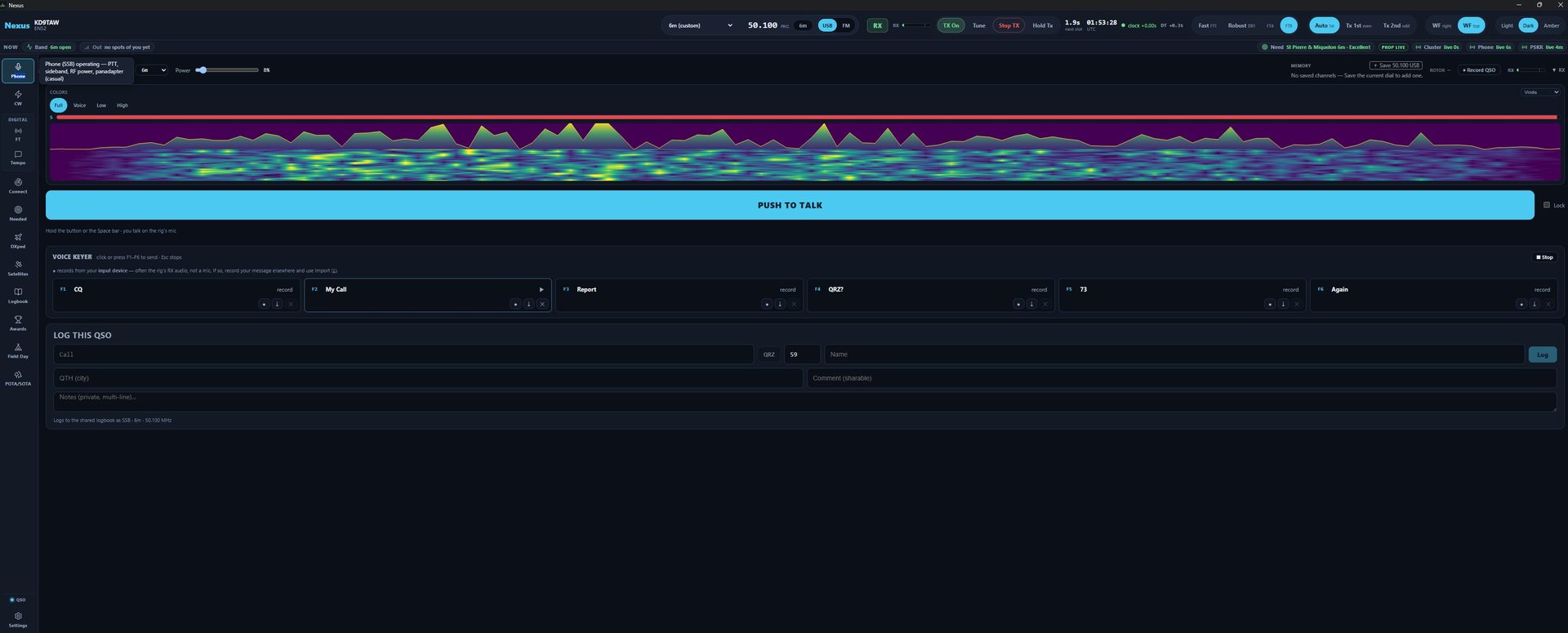
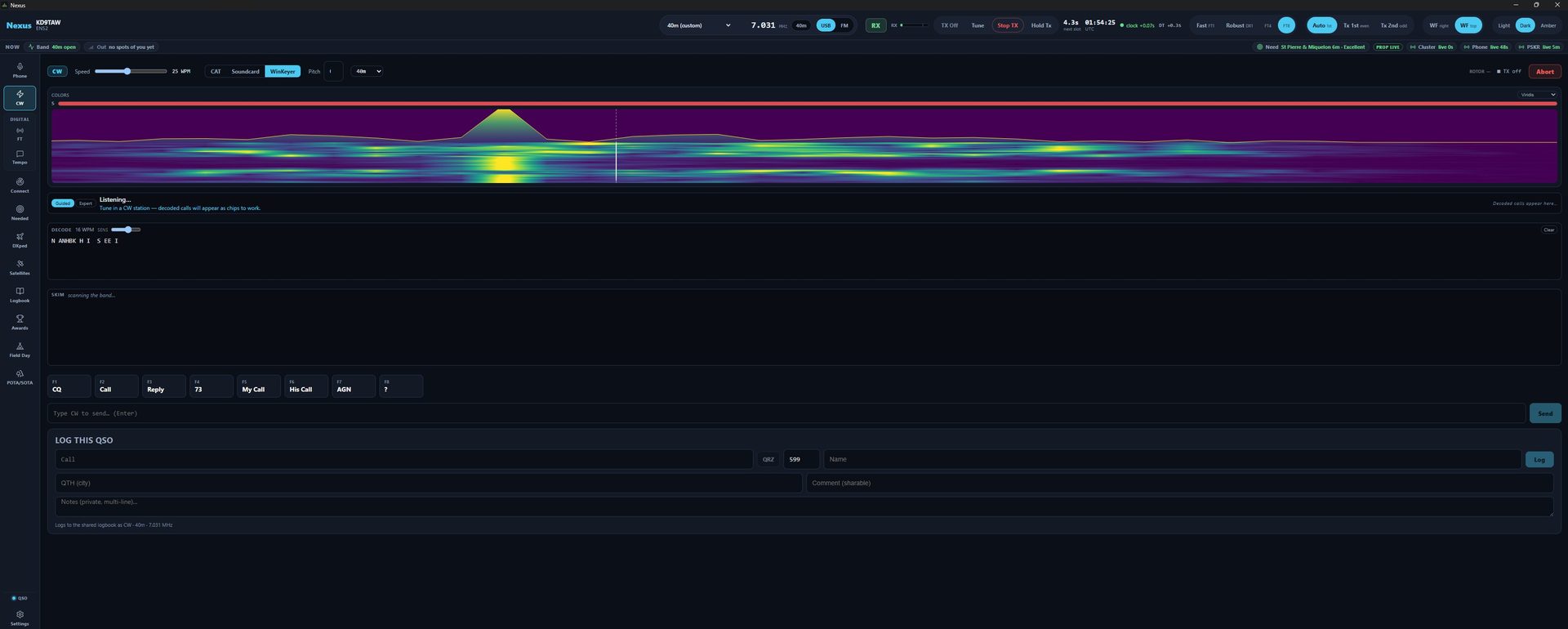
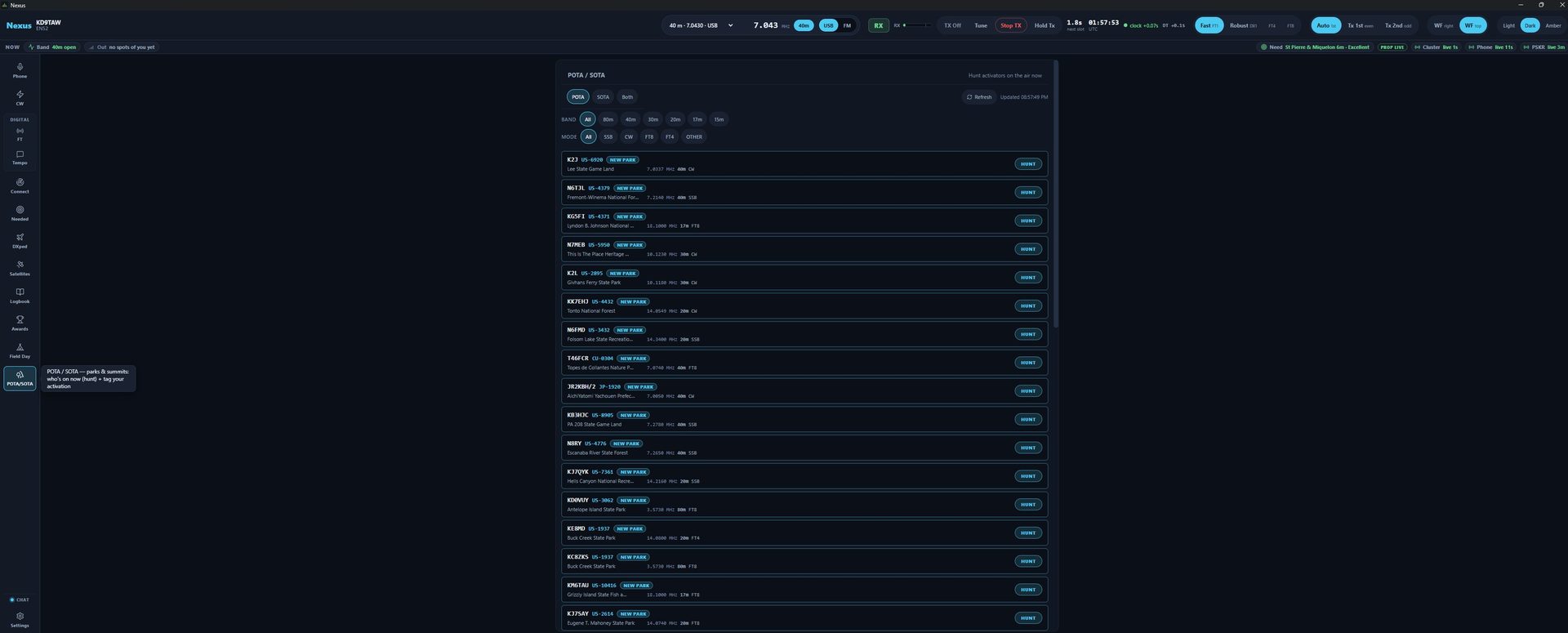
Phone gets a live bandscope, voice keyer, and SSB + FM with repeater shift and CTCSS. CW gets keyboard keying (CAT, soundcard, or a K1EL WinKeyer), macros, and a live decoder. Satellites get pass schedules, polar plots, and rotor auto-track through a pass. Field Day, POTA, and SOTA are built in.
FT1 & DX1 — new protocols, honest numbers
The built-in Tempo layer carries threaded keyboard chat on FT1, a 4-second-cycle weak-signal mode with IR-HARQ retransmission combining, and DX1, a fading-resilient robust tier. FT1 trades ~6 dB of raw single-shot sensitivity against FT8 for a nearly 4× faster cycle — every figure simulation-validated, and proving them on the air is what the beta is for.
See it in action
One window, the whole station
Every mode and tool in a single modern interface — instead of five aging apps wired together over COM ports and TCP.





Plays well with your shack
Nexus speaks WSJT-X's UDP protocol byte-for-byte, so GridTracker, JTAlert, and your logger keep working unchanged. ADIF 3 logging with LoTW, QRZ, ClubLog, eQSL, and HRDLog connectors (credentials in the Windows keychain), N1MM+/N3FJP feeds for Field Day, PSK Reporter spotting, and a CAT broker so other apps can share the radio.
Open beta
The honest version
What's solid
The FT8/FT4 operating core is production-grade — over 800 automated tests, wire formats pinned. Field-verified end-to-end on a Yaesu FTDX10 and FT-991A, with FlexRadio and Xiegu verification in progress.
What's beta
The newest features — satellites, rotor tracking, 23 cm, the headphone monitor — are fresh from the bench. FT1/DX1 numbers are simulation-validated, not on-air-proven. Windows-only today; the installer is unsigned (verify the published SHA-256). Your field reports are the point: SourceForge Tickets.
Documentation
Start here
Under the hood
Curious how a 4-second weak-signal cycle with cellular-style retransmission combining actually works? The full FT1 protocol story — design, math, and the honest numbers — is on the protocol page.