Reference
Everything Nexus does
The complete list, grouped by operating surface. If you want the argument instead of the spec, that is on the front page. Everything here ships in v0.21.5.
Modes
Fifteen modes, transmit and receive
Every transmitting waveform is verified by generating a transmission in Nexus and having stock WSJT-X decode it, rather than by testing Nexus against its own decoder. Both halves come from the same vendored source, so a shared misreading would pass unnoticed.
| Mode | Direction | Notes |
|---|---|---|
| FT8 | TX + RX | Production core. WSJT-X sequencer parity, checked against a 207-row matrix. |
| FT4 | TX + RX | Production core. Clicking an FT4 spot switches the decoder to FT4. |
| Q65 | TX + RX | Waveform matched sample-for-sample against WSJT-X’s generator at 0.9985. |
| FST4 | TX + RX | LF and MF. Its own frequency table, not FT8’s. |
| FST4W | TX + RX | Beacon schedule by percentage, never touches the QSO sequencer. |
| MSK144 | TX + RX | Meteor scatter. Waits twelve periods before giving up, against FT8’s three. |
| JT65 | TX + RX | Verified by round-trip against WSJT-X’s own generator. |
| WSPR | TX + RX | Percentage schedule. 20 m WSPR is 14.0956, not 14.074. |
| TempoFast | TX + RX | Original 4-CPM tier, 4 s cycle, incremental-redundancy HARQ. |
| TempoDeep | TX + RX | Original non-coherent 8-FSK tier for fading paths. |
| RTTY | TX + RX | Soundcard AFSK and true FSK keyline, hands-free auto-sequencer. |
| SSTV | TX + RX | All fifteen modes, live waterfall that becomes the picture, FSK-ID capture. |
| APRS | TX + RX | AFSK-1200. Position, Mic-E, messages, objects, compressed, third-party. |
| SSB · FM | TX + RX | Repeater shift and CTCSS, voice keyer, bandscope, TX meters. |
| CW | TX + RX | CAT, serial keyline, K1EL WinKeyer or soundcard. Neural-net decoder. |
Each mode keeps its own operating rhythm rather than inheriting FT8's, and each lands on its own calling frequency read from WSJT-X's own table. The FT8 and FT4 decoder is built from WSJT-X's DSP sources, currently tracking upstream 3.0.2; on identical recorded audio its floor measures −21.3 dB against stock's −20.7 with no false decodes, and it is tested against pure noise, where it returns nothing. Rovers keep decoding here: upstream 3.0.2 drops /R calls outside contest mode, Nexus keeps them, and a test fails if that regresses.
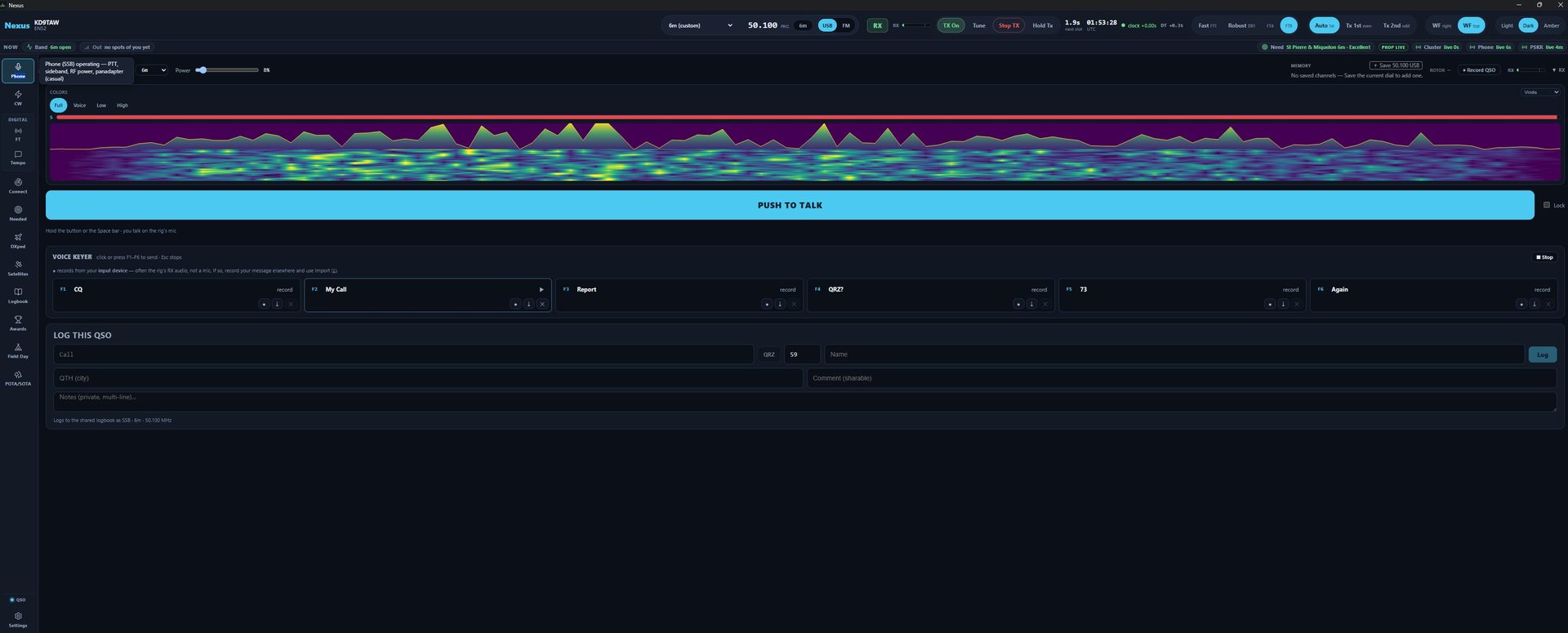
Phone cockpit
SSB and FM with a live bandscope, transmit meters, a six-slot voice keyer, repeater shift and CTCSS. On a native-CI-V Icom or a network Flex this scope is the radio's own RF spectrum rather than 3 kHz of soundcard audio.
Radios
Rig control, and the panadapter
On the radios that can stream it, Nexus shows the rig's own spectrum and mirrors the front-panel DSP controls.
| Path | Applies to | What you get |
|---|---|---|
| Native CI-V Icom | IC-7300 · 7610 · 9700 · 705 · 905 | The rig’s own spectrum scope as a real RF panadapter, plus AGC, NR, NB, notch, filter width, mic gain and SWR/ALC/power/comp meters on the rig’s calibration curves. |
| FlexRadio | SmartSDR over the network | VITA-49 panadapter, DAX receive and transmit audio, native meters. Opt-in, off by default, not yet confirmed on hardware here. |
| Everything else | ~50 rigs curated, Hamlib bundled | Yaesu, Kenwood, Elecraft, Xiegu and the rest. Click-to-tune and drag-a-passband still work on the audio scope. |
| Interfaces | Digirig · RIGblaster · SO2R | Recognised by name and paired with their sound device. Per-radio keying port, so PTT follows the rig you switch to. |
| Multi-radio | Up to three rigs | All permanently connected and monitored, instant handoff with no CAT teardown, routing by band and mode. Peg-lock pins the active radio. |
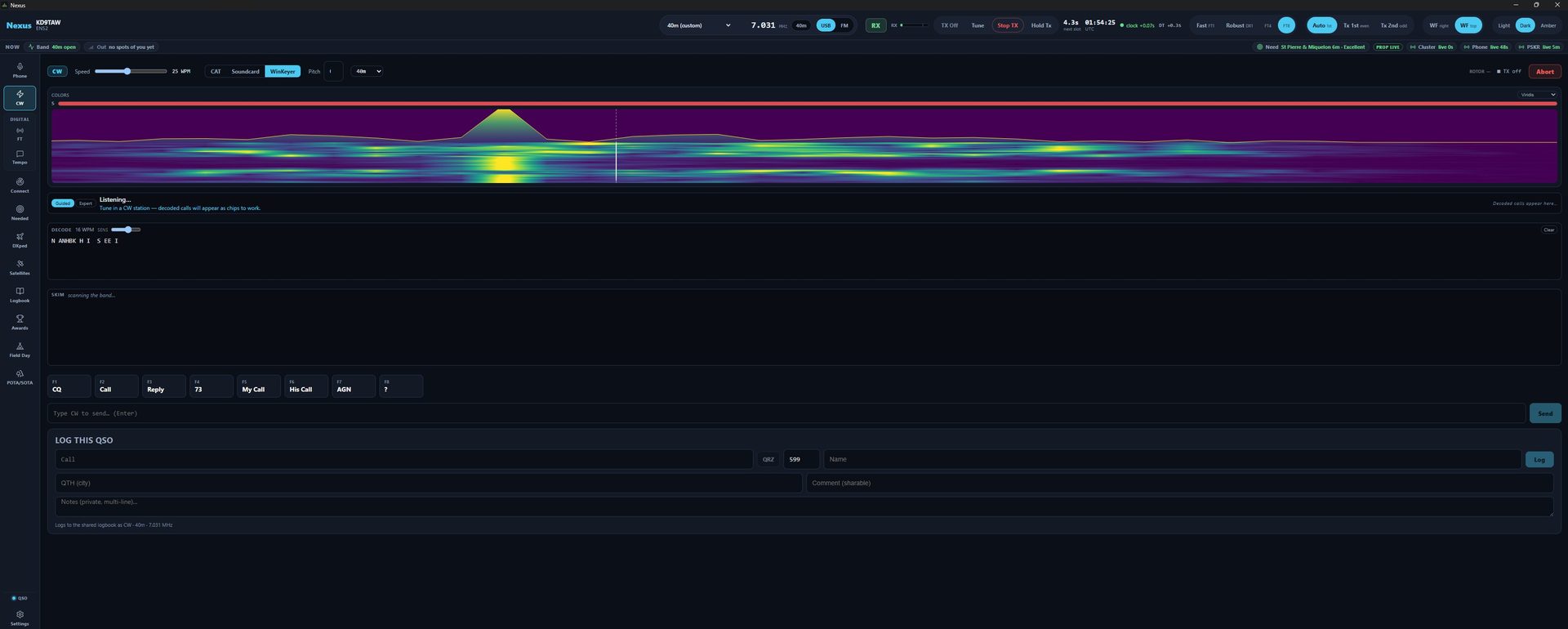
CW cockpit
Keying through CAT, a serial DTR/RTS keyline, a K1EL WinKeyer or the soundcard. The decode transcript is the dominant pane, driven by the DeepCW neural-net model, with the classic decoder as an automatic fallback. Macros can greet the other operator by name and send your state.
Chasing and logging
What it does with your log
The log drives everything else here: the needs engine, the awards math, and the colouring on every decode row and spot.
| Surface | What it does |
|---|---|
| Needed board | Every station ranked by what it is worth to your log, each row showing who near you heard them and when. Corroboration gates on VHF. |
| Pounce | Scores every skimmer and cluster spot as it arrives. Tone, desktop notification and banner on a new one. Never moves the radio itself. |
| State index | A packed callsign-to-state index from the FCC licence file, so NEW STATE resolves on CW, SSB and cluster spots that carry no grid. |
| Awards | DXCC, Challenge, Honor Roll, WAS, WAZ, per-band VUCC, IOTA. Computed offline. Source-aware confirmations. |
| DXpeditions | A month calendar, one coloured bar per operation, announced bands low-first, modelled best window, wake-me alarms, link to the team’s page. |
| Propagation | Native ITU-R P.533. Operator-anchored opening detector with Es/F2/aurora/tropo classification, tiered alerts, map sectors, a persistent openings log. |
| POTA · SOTA | Live activator spots, NEW PARK and BAND OPEN badges, one-click hunt, hunted-parks import. |
| Field Day | ARRL and Winter FD, correct date rules and scoring, 83-section board, Cabrillo 3.0, live N3FJP and N1MM+ feeds, journalled log. |
| Satellites | Pass schedules, polar plots, Doppler, true 3-D orbits with footprint rings, rotor auto-track through a pass. |
| Memories · Program | 11 curated packs, 172 channels, Ctrl+1–9 recall, net reminders. Repeater search with one-click starring, CHIRP CSV round-trip. |
Logging
Uploads and confirmations
Every push and pull keeps a per-contact record of what went where, which service confirmed, and at what award level.
| Behaviour | Detail |
|---|---|
| Push from the backend | Logged contacts go to LoTW, QRZ, ClubLog, eQSL, HRDLog, Cloudlog, DXKeeper and your contest logger as configured, from the backend — a closed window never loses an upload. |
| Rejections are visible | A refusal from TQSL is recorded as rejected and retried. Nothing sits marked sent that never arrived. |
| Edits re-send | Correcting a logged contact re-sends it, so the online logbooks match your log. |
| Confirmations keep their source | An eQSL or QRZ match shows as confirmed but never counts toward DXCC or WAS, because those awards do not accept it. The totals survive a real award application. |
| ADIF in and out | Import deduplicates against what is already logged, export goes straight to a file, and the raw logbook is backed up before every load. |
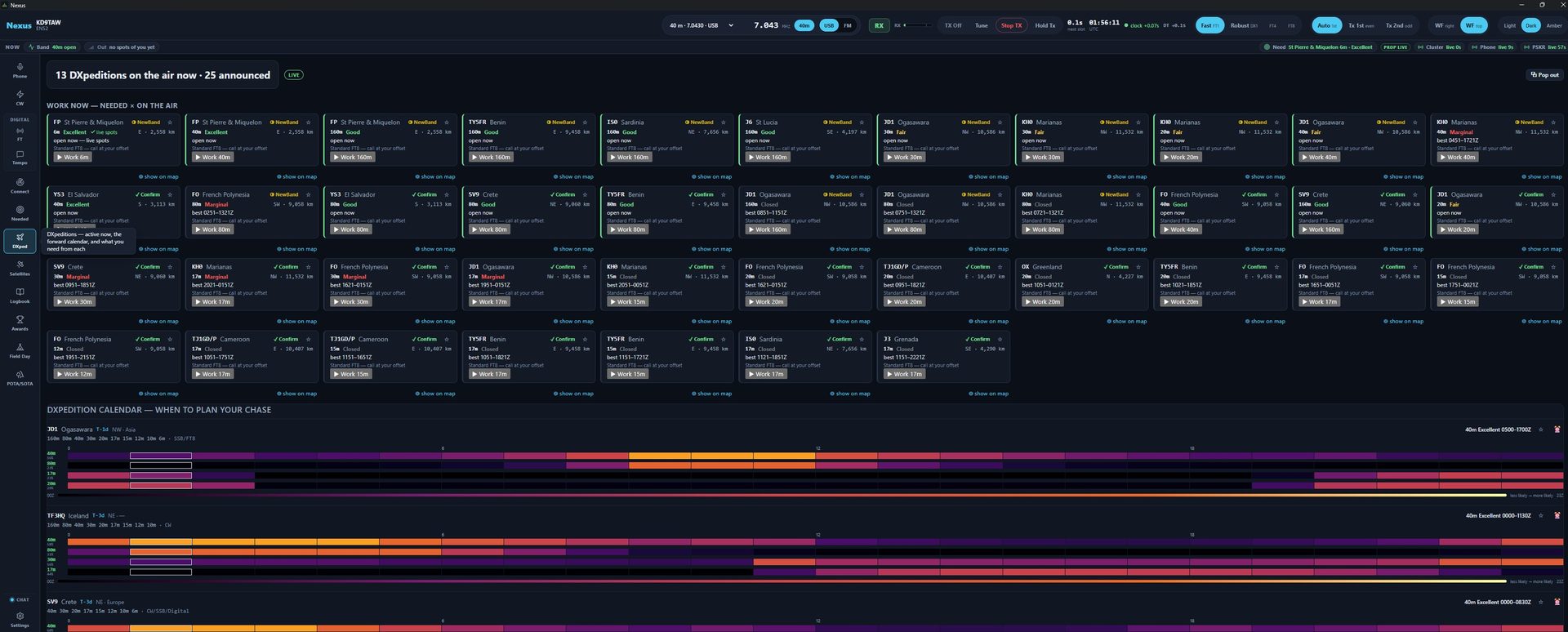
DXpedition calendar
Each operation is one bar across the days it is on the air, keeping its colour, carrying its announced bands low-first. Above it, a plain-language list of what to chase and the best day and time for each.
Station
Setup, safety and the things that keep it running
| Area | Detail |
|---|---|
| Setup | Three-step wizard. Reads USB descriptors, matches the rig, pairs the audio CODEC, links a missing driver. |
| Transmit safety | Your licence class is a hard lockout in every keying path, Part 97 sub-bands included. Per-mode power ceilings. A watchdog that covers beacons. |
| Launch behaviour | Opens the radio read-only and commands nothing until you act, so a rig parked on 40 m LSB for a net stays there. |
| Rig recovery | A radio that stops answering is retried with backoff to about 30 s and picked up within seconds of replying, with no restart needed. |
| Capability checks | Reads what the radio covers from its own table, so an HF-only rig is never commanded to 2 m. If the radio refuses a command, Nexus does not assume it worked. |
| Updates | Signed and verified, installed in place. Stands down while you are transmitting, tuning, in a contact or running CQ, and says which. |
| Crash reports | On Windows, a native report naming the component at fault. Addresses and module names only, no callsign and no log data. |
| Accessibility | JAWS and NVDA support with nothing to switch on. Keyboard-navigable boards, optional spoken decodes, TX/RX earcon. |
| Platforms | Windows x64, Linux .deb and AppImage, Raspberry Pi arm64 (Pi 3/4/5). Decode depth Fast keeps a slower Pi real-time. |
Diagnostics
When nothing is happening
A dead band, a deaf receiver, the wrong sound card, a clock error and a radio on the wrong frequency all present identically — as silence. Nexus names which one it is.
| Silence | What the readout shows |
|---|---|
| Wrong frequency | "On 144.174 USB, APRS needs 144.390 FM", with a Tune button beside it. Judged against the channel you selected, so 144.800 in Europe reads as correct. |
| Closed squelch vs. dead sound card | Reported separately — only one of them is a problem — with the input level in dBFS, so you can see what the decoder is actually hearing. |
| Which radio | On a multi-radio station the decode readout names the rig it is listening to. |
| How fresh | Counts carry their age: "2 bursts heard since arming, last one 20 s ago", never a stale number presented as current. |
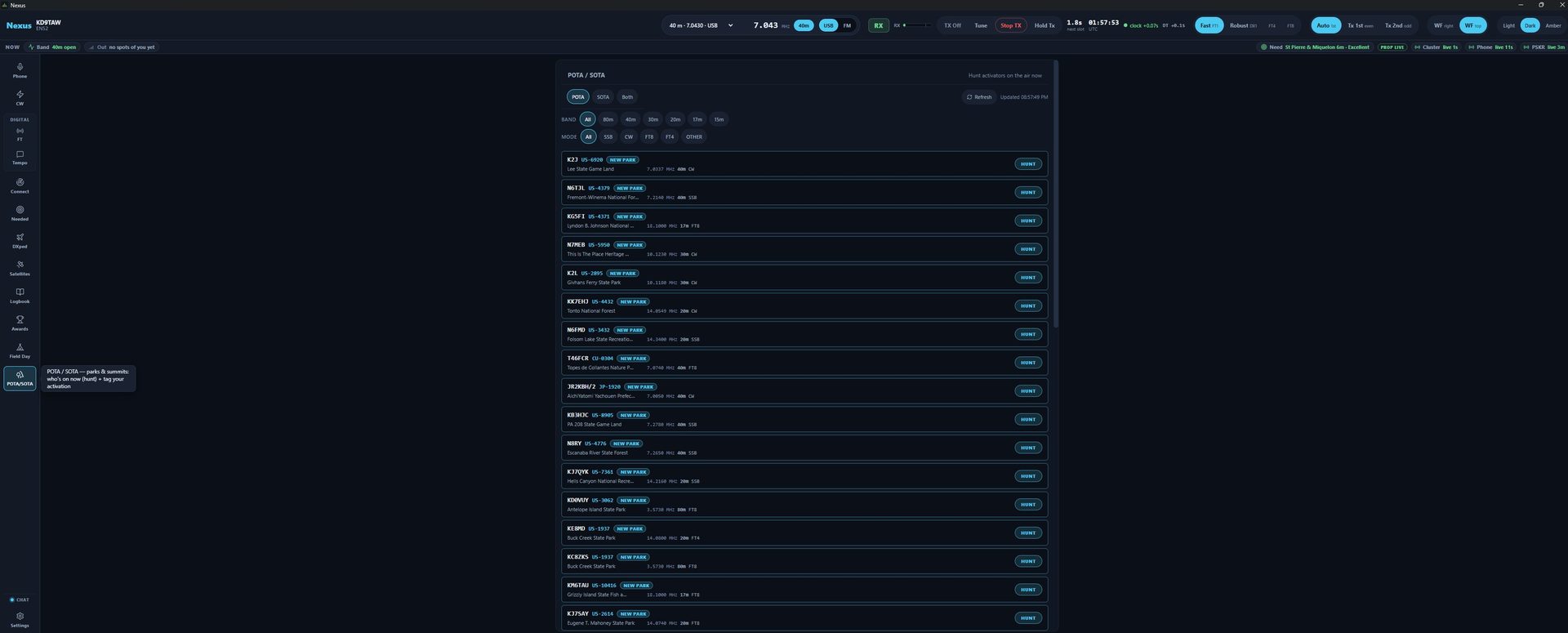
POTA · SOTA
Live activator spots with new-park flags and one-click hunt, sortable by workable-now, activator, reference, band and mode. This capture is from an earlier build; the surface has since gained the mode-designation and sorting work.
Original protocols
TempoFast and TempoDeep
Nexus carries two weak-signal waveforms of its own. TempoFast is a coherent 4-CPM tier on a four-second conversational cycle with incremental-redundancy HARQ, where a failed decode is not wasted because retransmissions combine until the message lands. No other amateur text mode accumulates redundancy that way. TempoDeep gives up the speed for a non-coherent tier that keeps working when the path is fading.
Both have closed real links on the air, including a completed two-station QSO on 6 m. TempoFast trades about 6 dB of raw single-shot sensitivity against FT8 for a cycle nearly four times faster, and every sensitivity figure quoted anywhere is still a bench number. Both waveforms are plain text with fully published specifications — nothing encrypted, nothing hidden.
| TempoFast | TempoDeep | |
|---|---|---|
| Modulation | 4-CPM h=1/2 BT=0.3 | Non-coherent 8-FSK |
| Detection | Coherent, turbo equalised | Non-coherent |
| T/R cycle | 4 s | 15 s |
| Occupied BW | est. 42–67 Hz | 50 Hz |
| FEC | LDPC(174,91) + CRC-14 | LDPC(174,91) + CRC-14 |
| HARQ | Yes, on by default | No |
| AWGN threshold | ≈ −15 dB (sim) | ≈ −18.6 dB (sim) |
| Fading penalty | Large (coherent) | ≈ 3.7 dB (sim) |
Not in it
What Nexus does not do
No contest modes
Field Day is the only event mode. There is no NA VHF, RTTY Roundup or WW Digi support.
If contesting is your main activity, N1MM+ remains the tool, and Nexus will feed it every contact over UDP.
No Fox role
Nexus can work a DXpedition as a Hound, but it cannot run one as the Fox.
SuperFox was investigated and abandoned: the upstream table file is licensed for use with WSJT-X only, which bars vendoring it.
No outbound iGating
APRS traffic from the internet is never transmitted on the air. This one is deliberate and permanent.
That direction means a radio keying up unattended, which is not something this app will do.
No digital-voice programming
DMR, D-STAR and Fusion repeaters are listed with badges so you know they are there, but Nexus cannot program them.
Nexus v0.21.5
Windows x64 · Linux .deb and AppImage · Raspberry Pi arm64 · GPL-3.0