Nexus manual · Operating
Phone (SSB)
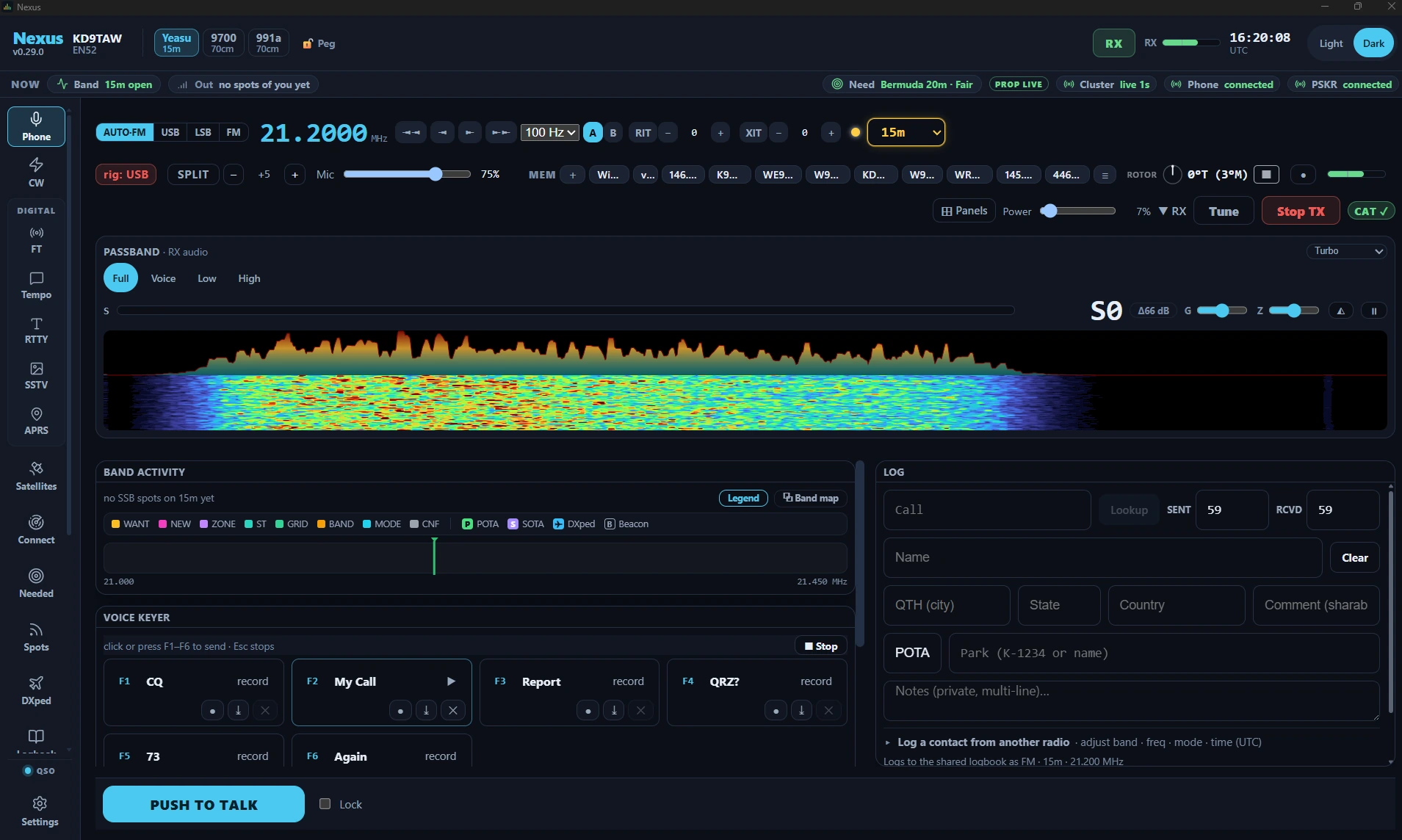
The Phone cockpit is a traditional rig-panel experience for voice operating — SSB on HF and FM for VHF/UHF and repeaters. It doesn’t try to reinvent voice — you talk on the rig’s own mic — but it gives you the shack-monitor conveniences a modern app should: live dial read-back, a fast colored bandscope, a voice keyer for the calls you make over and over, and crash-safe QSO recording, all with your logbook and license privileges wired in.
Phone ships enabled — the wizard turns everything on; there is no mode picker to miss it in. No goal profile enables it, though, so if you pick one in Settings ▸ Appearance ▸ Features, switch Phone back on there — or take Everything (expert), which includes it.
The tour
Live dial read-back. The cockpit polls the rig about every 750 ms: spin the
VFO knob and the displayed frequency follows. On SSB the sideband is automatic —
LSB below 10 MHz, USB above — so the rig lands on the right sideband for the band.
The mode chips — AUTO / USB / LSB / FM — set what the cockpit commands, and
AUTO shows the sideband it settled on (AUTO·USB, AUTO·FM). If the rig’s own
mode knob disagrees, a rig: badge appears beside them naming what the radio
is actually on; logging and TX follow the commanded mode until you match it up.
The bandscope is a fast (~30 Hz) colored display split into a panadapter trace and a scrolling waterfall, with per-frame AGC so signals stay visible as conditions shift. Span chips above the scope — Full / Voice / Low / High — zoom the view to the part of the passband you care about.
RF power slider. Wired to CAT and follows the rig: turn the rig’s power knob and the slider tracks it (it won’t sit lying at 100%). Your drags win while you’re dragging.
⊞ Panels in the header shows and hides the panes under the scope. Where there is something you would want to know before you tick — nothing on screen behind the box, or a consequence to unticking it — the entry says so in a line under it:
- Rig Scope Controls command the radio’s own panadapter (span sets the hardware sweep width, ref sets weak-signal visibility), so they appear only while an Icom CI-V or FlexRadio scope is streaming. On the audio bandscope there is nothing to command, and the entry says so. The span chips over the scope are a different thing: they zoom what is already on screen.
- DSP Functions (NB / NR / Notch / COMP / VOX) and RX DSP Levels (NR level, AGC) only ever offer what your radio reports over CAT. A rig that reports none of them has nothing for those panes to hold, and the entries say so rather than hiding an empty pane behind a silent checkbox.
- TX Meters (SWR / ALC / PO / COMP) read on transmit, so the panel is empty while you listen. The entry says when it reads.
- Voice Keyer puts the F-key message pane away if you work with a mic and never use it. Unticking it stops a message that is playing and throws away a recording you are part-way through making; the entry says both before you tick it, and Undo last change — which can put the pane away again — carries the same line before you press it. Whichever way the pane closes, including simply leaving the Phone screen, Nexus tells you what it ended: the over it cut short, or the recording it discarded. Nothing else changes: PTT, Tune and Stop TX are not panels and have no entry, so no layout you save can put them out of reach.
The line explains the screen; the tick is still yours. Every box in the menu can be ticked and unticked whenever you like, and what you choose applies the moment that panel has something to show — untick one now and it stays away when your rig starts feeding it. Once you have unticked an entry, its line goes with it: the pane is off your screen because you said so, and a note still blaming the rig would no longer be true. Tick it back and the line returns if it still applies. Each entry is a keyboard tab stop and reads its reason with the panel name; Esc closes the menu and puts focus back on the ⊞ button rather than at the top of the app. If the list outgrows your window it scrolls inside the menu, so Undo last change and Reset layout stay reachable.
The control column. Band Activity, the voice keyer and the rig-scope / DSP / RX-DSP strips share the leading column, and none of them can shrink. When the stack stands taller than the space it has — a small window, or a large UI zoom — that column scrolls, so the NR slider, the AGC chips, the DSP toggles and the keyer’s F-keys are always reachable rather than rendered past the edge. PTT, Stop TX and Tune are not in the pane region at all, so nothing you do in ⊞ Panels and no window size moves them.
Core workflows
Get on the air and make a call
- Set the band and frequency — type it, pick a band-plan channel, or just spin the rig’s knob and watch the read-back follow.
- Push to talk one of three ways:
- hold the on-screen PTT button,
- hold the Space bar (works unless you’re typing in a field),
- or let the configured rig method key it (CAT, serial RTS/DTR, or VOX) — set in Settings ▸ Radio ▸ Rig & CAT. For hands-free operating, toggle Lock.
- Talk on the rig’s microphone. Nexus handles the canned messages, recording, scope, and CAT/PTT — the voice path itself is the rig’s own mic.
- The cockpit unconditionally drops PTT when you navigate away, so there is no stuck-transmitter path.
Work FM and repeaters
- Set Phone mode ▸ FM in Settings ▸ Phone. The cockpit’s mode badge switches to FM and the rig is driven to FM.
- For a repeater, set the Repeater shift (simplex / plus / minus — the offset is the band standard, e.g. 600 kHz on 2 m, 5 MHz on 70 cm) and the CTCSS (PL) tone in the same Settings tab.
- Tune to the repeater’s output frequency and operate — Nexus applies the shift and access tone through CAT.
Use the voice keyer
The voice keyer has six F-key slots: CQ, My Call, Report, QRZ?, 73, Again.

The voice keyer in Nexus 1.10.3. F2 My Call holds a recording, so it shows a ▶; an empty slot reads record instead. ● records into the slot, the arrow imports a WAV, ✕ clears it, and the pane’s ■ Stop ends whatever is playing.
- Record in-app or import any WAV (Nexus resamples and downmixes automatically). Choose your recording mic in Settings ▸ Phone — on a digital setup the default input is the rig’s RX audio, so point “Voice mic (recording)” at your actual microphone. Both controls that start a recording — the ● button and an empty slot — carry that warning, so it reaches you where you are standing when it matters. Recording the rig’s RX audio into a slot is how a canned call goes on the air with the wrong voice in it.
- Press a slot to play it. Playback keys PTT for the duration; Esc aborts.
If you never use it, untick Voice Keyer in ⊞ Panels and the pane goes away. Closing the pane is itself a stop: a message that is playing is aborted rather than left transmitting behind a pane you just closed. A recording running at that moment is thrown away — Nexus says so when it happens, and the menu entry says so first. Leaving the Phone screen does the same thing, for the same reason: there is no abort button off-screen.
Record a QSO
QSO recording streams the rig’s RX audio straight to a timestamped WAV on disk, with crash-safe headers and a 2-hour auto-stop, so a long ragchew or a dropped session never leaves you with a corrupt file.

Where the recordings go, in Nexus 1.10.3 — the path shown is this station’s, and Open recordings folder opens yours. The per-period setting next to it is a decoder-debugging tool, not a QSO recorder: “All” writes about 2 GB a day.
Field Day and logging
The log strip pre-fills 59 / SSB. Log a contact and — because the draft is seeded from what you were actually running — it says SSB, never an accidental “FT8.” The Log button sits inside the log pane at every window from 1024×768 up, so committing a contact never means scrolling to find the button that commits it. The strip takes its name from the pane head above it (LOG), which is also what a screen reader reads — the printed repeat and the strip’s own inner card are gone, and that is where the height came from. Nothing is in a smaller type. During Field Day, the strip becomes an FD entry with class and section, sharing dupe checking with the other cockpits, and each contact routes to the event log.
License-class enforcement hard-blocks PTT outside your privileges — see Settings ▸ Station.
Honest limits
- No live mic-through-app audio bridge. You use the rig’s mic for live voice; Nexus handles canned messages, recording, the scope, and CAT/PTT — not a software voice path to the transmitter. This applies to SSB and FM alike.
Related guides
- CW
- RTTY — the teleprinter cockpit on the same rig: typed, not spoken
- SSTV — pictures in the phone segment, through this same transmitter
- APRS — the packet side of the same 2 m radio
- Memories — the bank behind this cockpit’s MEM strip
- Program — building the repeater channels you work here
- Operate — FT8/FT4 digital
- Field Day & POTA/SOTA
- Settings reference
This page is synced from docs/guide/phone.md in the Nexus repo. Corrections belong there.